
Analysis of butterfly count data by Xerces shows how monarchs are doing in the U.S.
And broken down by region
Hi everyone,
Today’s blog entry is focused on a little-known report that was made available by the Xerces Society last year. I bet a lot of people reading this didn’t even know about it too. It is available online here. It was a summary of a very large statistical analysis of summertime butterfly count data, that was conducted by a large team of butterfly scientists. This team had assembled data from every butterfly monitoring program in the U.S. (there are dozens) and statistically analyzed the long-term trend (from 2000-2020) of each species of butterfly in the country. The goal was to determine which species are in trouble, as in declining, and which species are not, as in, increasing or stable. And, the team even went further, by showing how the abundance trends varied in different regions of the country.
Suffice it to say, that this report was extremely thorough, and it was meant to be a document that helps target conservation efforts toward the species that need it the most. Indeed, there were a lot of species that seemed to be declining. There were some that were stable though, and some were even increasing. For the purposes of this blog entry, I went through the document and figured out the trends for monarchs, which I’ll report below.
First, I’ll put a screenshot of the map presented in the report that shows the different regions they identified (I added monarch pictures to it).
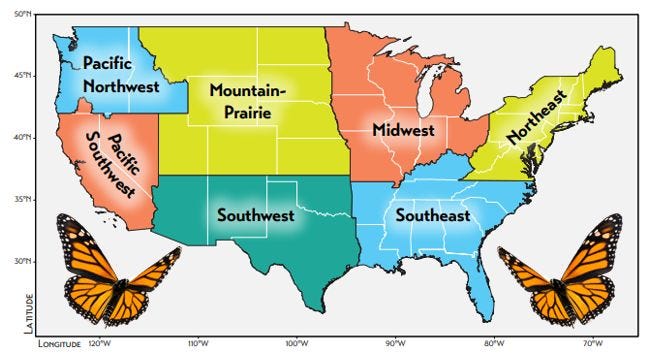
Next, I’ll tell you the trends that they reported for each region, starting in the east. Note that if you are following along in the report, keep in mind that the trends for monarchs were not given in certain regions, so I had to look them up in another document. Apparently, the Xerces document only reported the trends if they were statistically significant, as in, if the species was increasing or decreasing. They did not report if the species was stable, which I found odd. In those cases, I was directed (by Cheryl Schultz, the main author) to find the trends in a recent peer-reviewed study that used the same data.
OK, so here goes.
In the Northeast, the monarchs are increasing. This trend was statistically significant and very pronounced. In fact, the data shows a 78% increase over the 2 decades.
In the southeast, the monarchs are also increasing. This was significant, and the trend was a 47% increase.
In the Midwest, there was no significant change detected. This is one that I had to look up in the other report. The statistical tests were close to being significant, but the trend was only a 6% drop in abundance over 20 years, which is meaningless. Monarch numbers fluctuate more than 6% from year-to-year anyway.
In the Mountain Prairie, there was no significant change detected. For the science nerds, the statistical model in this case showed a p value of 0.529. For everyone else, this means there was no change in abundance.
In the Southwest, there was also no change detected. If anything, the statistical model suggested a slight increase, but again, this was not significant.
The Pacific Northwest had no report for monarchs, and I believe this is because of a lack of data from that region that the team could analyze. There are fewer monitoring sites in that area of the country, and, fewer monarchs anyway. I will note however that Dr. David James recently performed a “non-conventional” analysis of all of the citizen reports of monarchs in that region, and he showed that there was no decline in these reports over 12 years.
In the Pacific Southwest, the analysis showed a statistically-significant decline in monarch abundance. The model showed this decline was steep, i.e. a 53% drop over 20 years.
So to summarize, the regional analyses showed that monarchs are doing really, really well in the east, they are more or less stable in the Midwest and central part of the country, and in the west, they are experiencing declines at least in the southern part, as in, California.
Regarding California, I’ll add some more context here. I just now looked at iNaturalist, to see the sightings of monarchs for this year alone (2026), and the below map is what came up. I circled the region of interest.
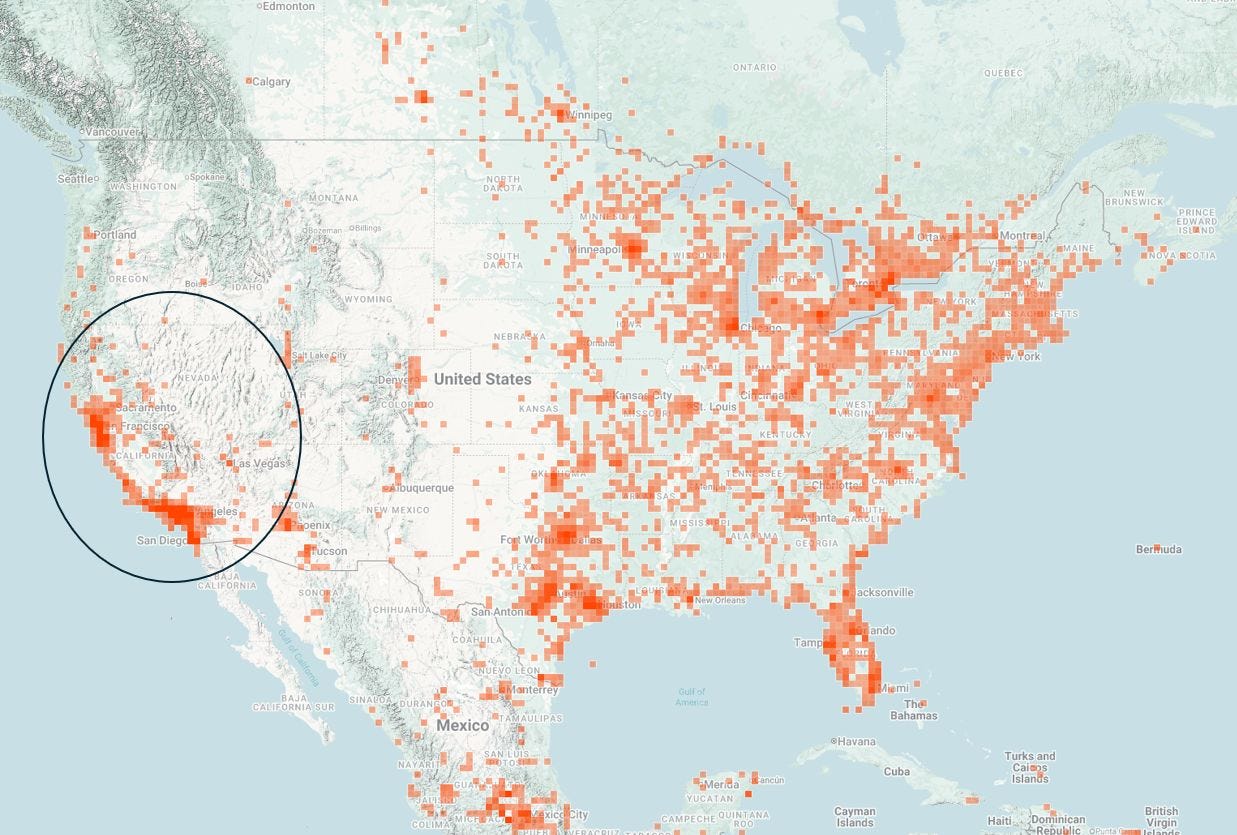
If you see what I see, then you’d be right to be confused over the reported decline in that region. I see two very red clusters of monarchs in California, which means, lots of monarch sightings. Remember, this map is just showing the sightings from this year. I guess it’s possible that those two spots were not included in the analyses, because there were no breeding butterfly surveys there. But either way, these two spots are troubling to me for a different reason. These are most likely, growing pockets of permanently-resident monarchs, which are growing because of people who plant non-native milkweeds. Ironically, people are doing this to provide “more habitat” for monarchs, which they have been told are in trouble. In fact, I’m even worried that if people in that region see this blog post, then they will even take steps to plant MORE non-native milkweed, thus perpetuating this cycle.
But ARE monarchs really in trouble in the U.S.? According to this report, they are not. Remember, the vast majority of monarchs in North America (99% of the population) lives east of the Rocky Mountains. And, in those regions, according to this analysis, they are doing fine.
Let me end this post by reiterating the main goal of the Xerces report, which was to identify butterfly species that are in trouble. It seems that there are a lot of species in trouble, but monarchs are not one of them.
That’s all for now.
*************************************************************************************************************
Some housekeeping stuff…
Thanks for reading MonarchScience. The posts are publicly available and free to share
Also, consider subscribing for free to get email notifications of new entries
And if you REALLY love this blog and want it to continue, consider buying me a coffee (or a beer), by clicking the button below. This is not a subscription cost or recurring fee. But this WILL motivate me to keep these informative posts coming!
*************************************************************************************************************